
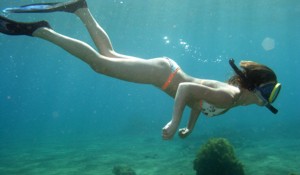
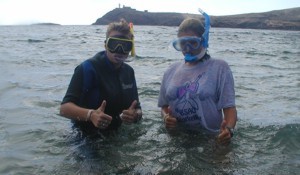
Snorkelling is an easy way to appreciate the diversity and beauty of the underwater life in Gran Canaria. With no more equipment than a mask and a snorkel you can float around and watch the smaller and more common species with ease.
We have listed some of the sites where you can snorkel with ease, and some useful tips for snorklers in Gran Canaria. To see the typical fish and marine creatures you may find look at the gallery of common fish species.
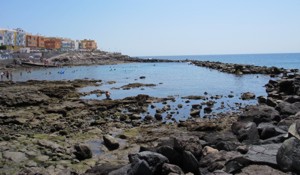 Zoco Negro in Arinaga
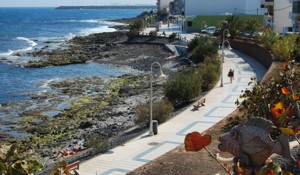 Risco Verde
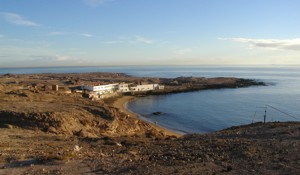 Playa del Cabrón near Arinaga
There are several places around the town of Arinaga on the east
coast where conditions can be excellent for snorklers. If you have not much experience, then
you can start at Zoco Negro, in the centre of Arinaga. This has an artificial sea wall
which has been positioned to creat a safe, shallow bathing area inside it. Despite the large number of people who
love to swim and play in the area, it is still full of brightly coloured fish including damselfish, wrasse,
blennies, bream and mullet. Over the years we have even seen rays and angel sharks in the deeper corners, so almost anything can come in at high tide!
Just along the coastal promenade, Risco Verde is fully open and
has a bit more depth, and provides another nice location with good
access and parking. Also in the Arinaga area the area in front of the Muelle Vieja and around the new
Muelle in the centre of town provide good access points and plenty
of marine life.
The best place in the area for snorkelling is probably the sheltered beach at 'El Cabrón' where there
are small volcanic reefs, areas of sea-grass and a profuse marine
life all within 20 yards of the beach. The access by road is
however less than ideal as the last kilometer is on a dusty unmade
track. All of these are within the area of the proposed
Arinaga Marine Reserve. Local Diving Centre in Arinaga For more details of snorkelling in El Cabrón
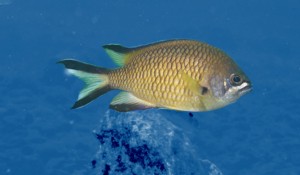 Atlantic Damselfish are very common
This is a small beach just before Playa del Inglés and the sand dunes. Due to its rocky bottom it does have some snorkelling, however the water gets deep very quickly and the visibility is often bad. However the walk between San Augstin and Playa del Ingles is great for spotting crabs on the rocky shore.
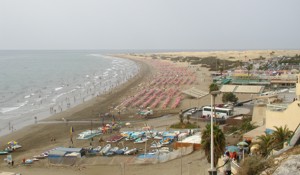 Playa del Ingles and the dunes of Maspalomas
The sand dunes of Maspalomas have little to offer the snorkeller due to bad visibility, lack of marine life and also high waves, the beach is more popular with windsurfers and surfers. However to the right of the lighthouse the beach is of a rocky composition. At high tide these rocks are covered with water and the marine life is brought closer to shore. However care should still be taken and this site not attempted if there are high waves. It is advisable to go the short distance further round to Playa Meloneras.
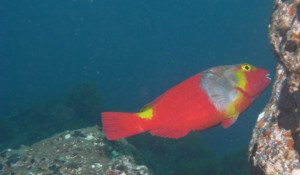 Parrotfish
This stony beach attracts many of the smaller species found in the canary islands and is much more sheltered than Playa Maspalomas. There are plenty of fishermen at this site so care should be taken with lines. When snorkelling stick to the rocky areas and stick within the beach area. Round the right corner the currents can get strong leading to Pasito Blanco.
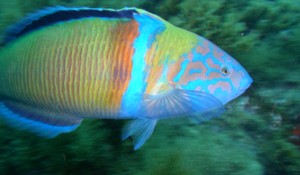 Turkish Wrasse
This area used to have a family of Turtles which have been spotted by snorkellers, however this is very rare and the harbour of Pasito Blanco is private and the bay not accessible by car. Walking to the right from Playa Meloneras at low tide it is possible to walk to the bay of Pasito Blanco. The snorkelling here is very similar to Playa Meloneras.
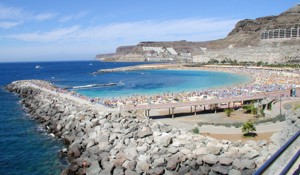 Playa de Amadores
Amadores is best snorkelled first thing in the morning, the popularity and fine composition of the beach can drastically reduce the visibility later in the day. Early in the morning the beach although sandy attracts flounders, breams, pufferfish and damselfish. In the centre of the beach there is a small cluster of stones which can also attract the wrasses and parrot fish. The more experienced snorkeller at any time of day may enjoy snorkelling on the right hand side of the bay following the break waters out. The large concrete blocks have become a food source for the fishes and it is possible to spot octopus and cuttlefish along this area. Care should be taken however of the pedalos and other surface traffic in this area.
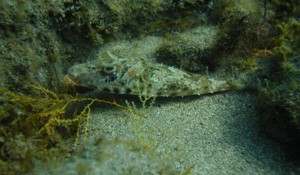 Brown Puffferfish
The left hand side of the Tauro bay has more life and is a easy snorkelling area. Staying close to the shore line or the break water keeps the snorkeller in shallow water (2 to 3 meters) and many fishes can be seen. The waters in this bay are very calm and very suitable for beginners.
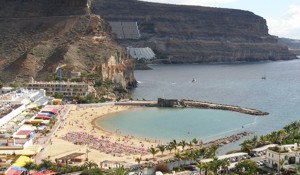 Playa de Mogan
The beach of Puerto Mogan in the new town area is a great place to snorkel for beginners. The beach is very sheltered and can be thriving with marine life. Those more advanced snorkellers may like to snorkel out along the right hand side break water which can attract more marine life.
 Puerto de las Nieves
The beach to the left of the pier has some great snorkelling on offer, however the current can be very strong so a good swimming ability is necessary. The barren bottom is dotted with patches of seaweed and rocks and these attract shoals of fish such as Wrasses, Breams and Parrotfish. It is also possible to spot lizardfish and cuttlefish in this area. The best idea is the let the currents carry you round keeping an eye on the shore, remember to save some energy however for the swim back to shore.
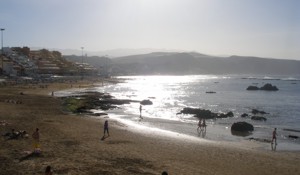 Playa de las Canteras
The weather in Las Palmas can be very unpredictable it is much cooler than the south of the island and much windier. Las Canteras beach can be found on the west side of the city, the beach itself is more than 2km long. The best place for snorkelling is a small inlet called Playa Chica in front of the Hotel Gran Canaria. Snorkel here only when the tide is low, and stay between the beach and the visible reef. The currents past this reef are very strong. This area is very shallow around 2 m but is teaming with life, Parrotfish, breams, lizardfish, wrasses, and damselfish are clearly evident. Those with a keen eye may also spot flounders, stargazers, morays, octopuses or trumpetfish up near the reef.